
Waring is a speck on the map with an outsized setting. Twelve miles north of Boerne and seven miles downstream from Comfort, it is strung along the banks of the Guadalupe River in northwestern Kendall County. A handful of homes, the old Waring General Store, a schoolhouse and church from another century, and the trace of the rail line that put the place there in 1887. People who own property in Waring tend to love two things above all: the river and the quiet. What they do not always think about, at least until something goes wrong, is the plumbing that keeps a rural river property livable. Out here it works differently than it does in town, and the worst problems have a habit of showing up when no one is around to catch them.

Waring started in 1887 as Waringford, named by R. P. M. Waring, an Irishman who gave the San Antonio and Aransas Pass Railway a right-of-way for its line toward Kerrville. The name was shortened to Waring in 1901. For a few decades, the little town had general stores, a grist mill, a cotton gin, a stone quarry, and a hotel, before the trains stopped running in 1970 and the community settled into the quiet river town it is today. The stretch of the Guadalupe between Comfort and Waring has long been retreat and summer-camp country, lined with cypress and drawn on by people looking for a place on the water. That history still shapes the area. Properties here range from full-time ranch homes to weekend places and river retreats, and almost none of them sit on a city water line.
Waring began in 1887 as Waringford, named for R. P. M. Waring, who gave the San Antonio and Aransas Pass Railway a right-of-way for its Kerrville line. The trains stopped in 1970, leaving a quiet community on the banks of the Guadalupe River, twelve miles north of Boerne.
Waring has no municipal water or sewer, so nearly every property runs on a private well and a septic system. That makes each owner responsible for their own water quality, water pressure, and wastewater.
On a part-time property, a failed supply line or water heater can run for days before anyone notices, and on a well, it runs the pump the whole time. A main shutoff used during absences, or an automatic leak-detection valve, prevents the empty-house flood.
Like the rest of rural Kendall County, Waring has no municipal water or sewer service. Every property runs on a private well, a septic system, and often propane for gas. The owner is the water utility, the wastewater department, and the person responsible when any of it stops working. The groundwater here comes from the Trinity Aquifer, the limestone source under most of the Hill Country, and it comes up hard, carrying calcium and magnesium that scale water heaters and crust fixtures over time. A water test sets the hardness, along with any iron or sediment, and from there a softener and the right filtration handle it. That treatment matters on any rural property, but on a Waring River place there is a second question that matters just as much, which is what happens to all of it when the owner is not there.
The hardest plumbing problems on a part-time property are the ones that happen when no one is home. A supply line under a sink lets go, a water heater fails, a toilet valve sticks open, or a washing machine hose drips. In a house someone lives in, a problem like that gets noticed within minutes. In a weekend place in Waring that sits empty from Sunday to Friday, or a river retreat closed up for the season, the same failure can run for days or weeks. Water keeps flowing from the well the whole time, which wastes it, runs the pump without rest, and can soak floors, walls, and cabinets long before anyone walks back in. On a private well, a leak that never stops can burn out the pump on top of the water damage. This is the core of plumbing for a part-time property in Waring, and it is where a little planning pays off the most.
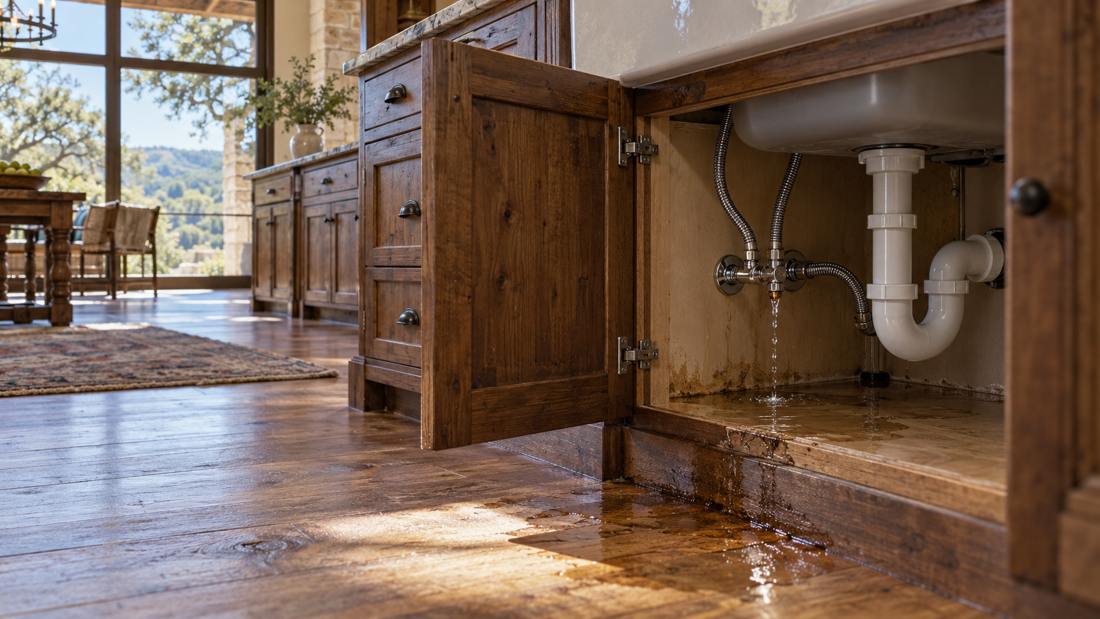
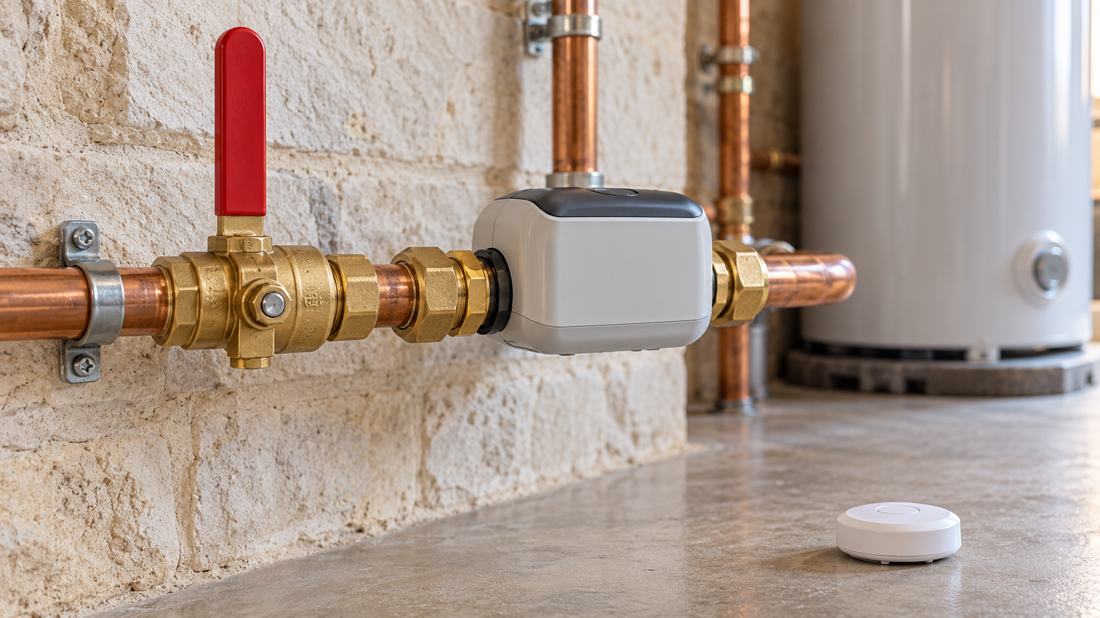
The simplest protection costs nothing. When a Waring property is going to sit empty, shutting the water off at the main or at the well pump stops any leak before it can start. For longer absences, draining the vulnerable lines takes the risk down to near zero, since there is no water left in the pipes to escape. Knowing where the shutoff is and how to use it is worth sorting out before the first long trip away, not in the middle of a crisis. Setting the water heater to its vacation or low setting while the place is empty saves energy and eases the strain on the unit. For an owner who wants more protection, a leak-detection shutoff valve is worth considering. It watches the flow and cuts the water automatically when it senses a leak, which is exactly the kind of insurance a property nobody checks daily can use.
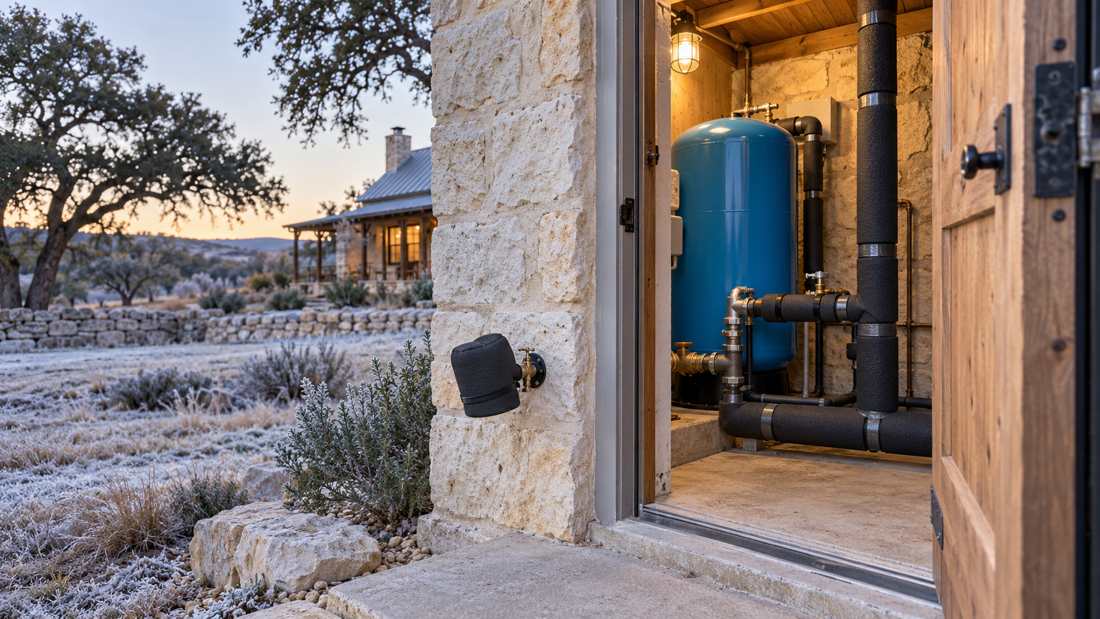
A hard freeze is a threat to any Hill Country property, as the February 2021 freeze made clear across the region. On a part-time place, it is worse, because there is no one there to drip the faucets, watch for trouble, or catch a burst line while it is still a small problem. Exposed well equipment, pump houses, outdoor spigots, and any pipe in an unheated space all sit at risk, often far from the house. A line that bursts in an empty Waring home can run until the next visit, turning a frozen pipe into a flooded floor. Protecting a seasonal property before winter means insulating the well and the exposed lines, adding heat tape where it helps, and either leaving minimal heat on or draining the system entirely if the place will be closed through the cold months. Winterizing ahead of time costs far less than the repair and cleanup that follow a freeze nobody was there to stop.
The Guadalupe is the reason to own in Waring, and it is also a factor to plan around. River-adjacent land tends to have a higher water table, and the placement of the wellhead and the septic system deserves real thought on property that sits near the water. A wellhead should stay protected and above grade so surface water cannot reach it, and a septic system should be sited and maintained so it keeps working and does not foul the ground near the river. Owners who know where their well, tank, and drain field sit, and keep them in good shape, are in a far better position than those who have never looked. Keeping those rural systems healthy on a river property is the kind of work Gottfried Plumbing handles across Waring and northwestern Kendall County.
Reopening a property that has been shut up for weeks or a whole season is its own small project, and rushing it is how a good weekend turns into a wet one. Before a Waring place goes back into full use, a few things are worth checking:
A quick walk through that list, or a short visit from a plumber before the season starts, catches small problems while they are still small and cheap to fix.
Gottfried Plumbing LLC works rural and river property across northwestern Kendall County from its Boerne shop at 607 E Blanco Road, about twelve miles south of Waring in the same county. The work covers the whole picture a Waring property needs: well pump and pressure tank service, water testing with softener and filtration for hard Trinity water, water heater repair and replacement across Navien, Rinnai, Rheem, and the major tank brands, whole-house shutoffs and leak detection for part-time properties, freeze protection and winterizing, and drain and septic line service. As a Texas State Board of Plumbing Examiners licensed contractor on a 24-hour-a-day, 7-day-a-week schedule, it handles the burst-pipe emergency that happens while an owner is away as readily as the planned work that keeps a river place reliable. Waring property owners can see the service details at gottfriedplumbing.com/waring-tx or call (830) 331-2055 for a free estimate.
Redirect to:
|
This page is a redirect. The following categories are used to track and monitor this redirect:
|
The biggest risk on a property that sits empty is a leak or burst pipe that runs for days before anyone notices. The practical answers are knowing where the main shutoff is and using it when away, setting the water heater to a vacation setting, and considering a leak-detection shutoff valve that cuts the water automatically. On a Waring well, a running leak also wears out the pump, so protection matters even more.
Waring has no municipal water or sewer, so nearly every property runs on a private well and a septic system. The groundwater comes from the Trinity Aquifer and tends to be hard, which is why many homes add a water softener and filtration after a water test. There is no treatment upstream, so whatever the well delivers is what the plumbing lives with.
Insulate the well equipment and any exposed lines, add heat tape where it helps, and either leave minimal heat on in the house or drain the system before a hard freeze if the place will be closed. An empty home has no one to drip faucets or catch a burst pipe, so a line that freezes can run until the next visit. Winterizing ahead of a cold stretch is far cheaper than the repair afterward.